
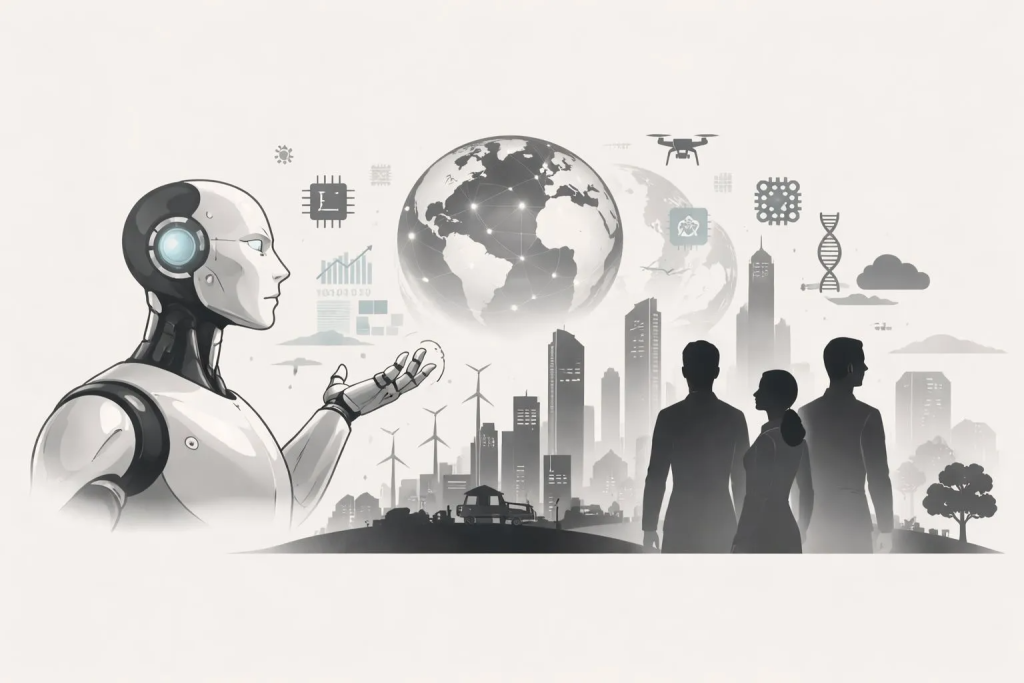
Most books about the future focus on technology, artificial intelligence, or life on other planets. Our Future World: Caring, Sustainable, Biodiverse by Alan Emery takes a very different path. Instead of asking what machines will become, it asks what humanity will become.
That question may be more important than ever.
This book is not written as distant science fiction or abstract theory. It is a deeply reflective and carefully researched exploration of the direction our world is currently heading environmentally, socially, economically, and politically. At the same time, it offers something many discussions about climate change and global instability fail to provide: hope.
Alan Emery approaches the future with honesty. He does not avoid difficult realities such as climate change, biodiversity loss, economic inequality, resource depletion, and the growing instability shaping modern society. But rather than leaving readers with fear or helplessness, he challenges them to think differently about what kind of world can still be built.
One of the strongest aspects of the book is the way it combines science with humanity. Emery does not simply discuss data, systems, or predictions. He consistently brings the conversation back to people, communities, empathy, cooperation, and the responsibility humans have toward one another and toward nature itself.
The book repeatedly emphasizes a powerful idea: survival alone is not enough. A successful future must also be caring, equitable, and sustainable.
Throughout the pages, readers are encouraged to rethink modern systems that prioritize endless growth, exploitation, and short-term profit over long-term human well-being. Emery explores how communities, innovation, renewable energy, ecological restoration, and cooperative thinking could help humanity avoid the worst outcomes of environmental and social collapse.
What makes the book especially compelling is its realism. It does not pretend the solutions are simple. In fact, the author openly acknowledges how difficult meaningful change will be. Yet even in its most cautionary moments, the book maintains an underlying belief that humanity still has the ability to adapt, rebuild, and create something better.
There is also a deeply personal tone woven throughout the work. Emery’s reflections, observations, and lifelong curiosity about the natural world give the book warmth and authenticity. It reads less like a detached academic analysis and more like a conversation with someone who genuinely cares about the future generations inheriting this planet.
At a time when many people feel overwhelmed by global uncertainty, Our Future World stands out as both a warning and an invitation, a warning about the consequences of ignoring the problems already unfolding around us, and an invitation to imagine a future built on cooperation, sustainability, and empathy instead of division and exploitation.
This is not simply a book about climate or politics.
It is a book about the kind of civilization we choose to become.