
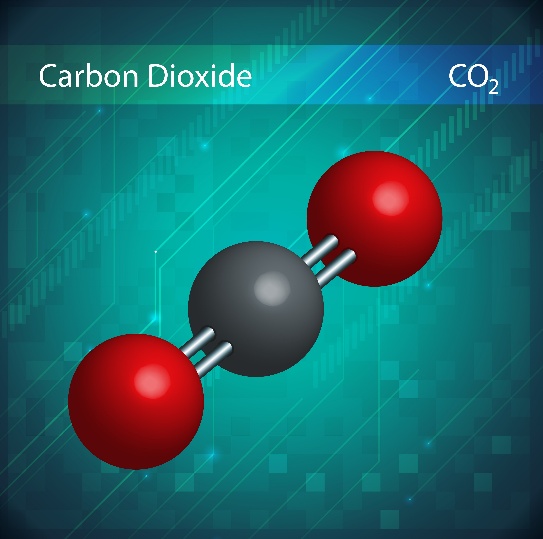
If the amount of carbon dioxide (CO2), a greenhouse gas, increases in the atmosphere, it causes the temperature of the planet to warm up.
It does this by capturing and releasing the heat (infrared rays) and then releasing it randomly in 360 degrees around itself. This slows the loss of heat from the surface as it rise toward space.
If the global temperature rises too much, it can cause many damaging effects and could topple human society. Most of the new CO2 is from burning fossil fuels. That means if we move away from fossil fuels to other energy sources such as solar, wind, nuclear power, or deep geothermal energy, we solve the problem of extra CO2.
How do we know the extra carbon dioxide (CO2) comes from fossil fuels?
There are several techniques we can use to determine if the extra CO2 in the air is from natural sources or from fossil fuels.
For example, we can use isotopic analysis. Carbon has three main isotopic forms: 12C, 13C, and 14C. Carbon-14 is radioactive with a half life of about 5,730 years. Fossils from which the fossil fuels come are millions of years old, so the carbon stored in the fossil fuels has no carbon-14 left, only carbon-12 and carbon-13.
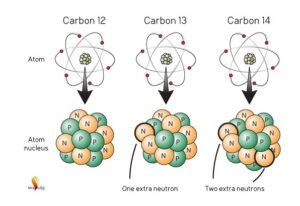
With Thanks to David Kirtley for the illustration
This means when fossil fuels are burned the CO2 has no 14C left and over time, the fossil fuel carbon dilutes the natural atmospheric carbon. By measuring the change, we can detect the diluting effect of the fossil fuel CO2.
Another test is to look at the ratio of 12C to 13C. Plants use the 12C more than the 13C in photosynthesis. The more fossil fuels we burn, the lower the amount of 12C in the atmosphere.
A third test is a bit unnerving. When fossil fuels are burned, they use up oxygen in the air. Since we began burning fossil fuels, the amount of oxygen loss exactly matches the amount used by burning fossil fuels. This drop in atmospheric oxygen is not dangerous yet, but we must be careful.
Finally, we know from ancient air trapped in ice cores from the Antarctic and Arctic that the CO2 levels for the last million years never rose much above 300ppm. But since the use of fossil fuels, it has rapidly risen to nearly 430ppm. The amount of CO2 released from fossil fuels exactly matches the amount released from fossil fuels.
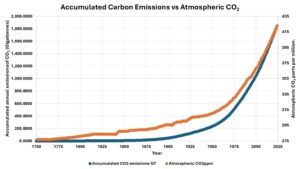
Now we know the main physical and chemical culprit for global warming is fossil fuel burning. If we know that switching away from fossil fuels would solve the problem, why aren’t we doing it?